At the wheel of the new Audi Q7 2026: a large luxury SUV that surprises with its agility and still bets on diesel
 Antonio Roncero @roncero_antonio
24 October 2026
24 min.
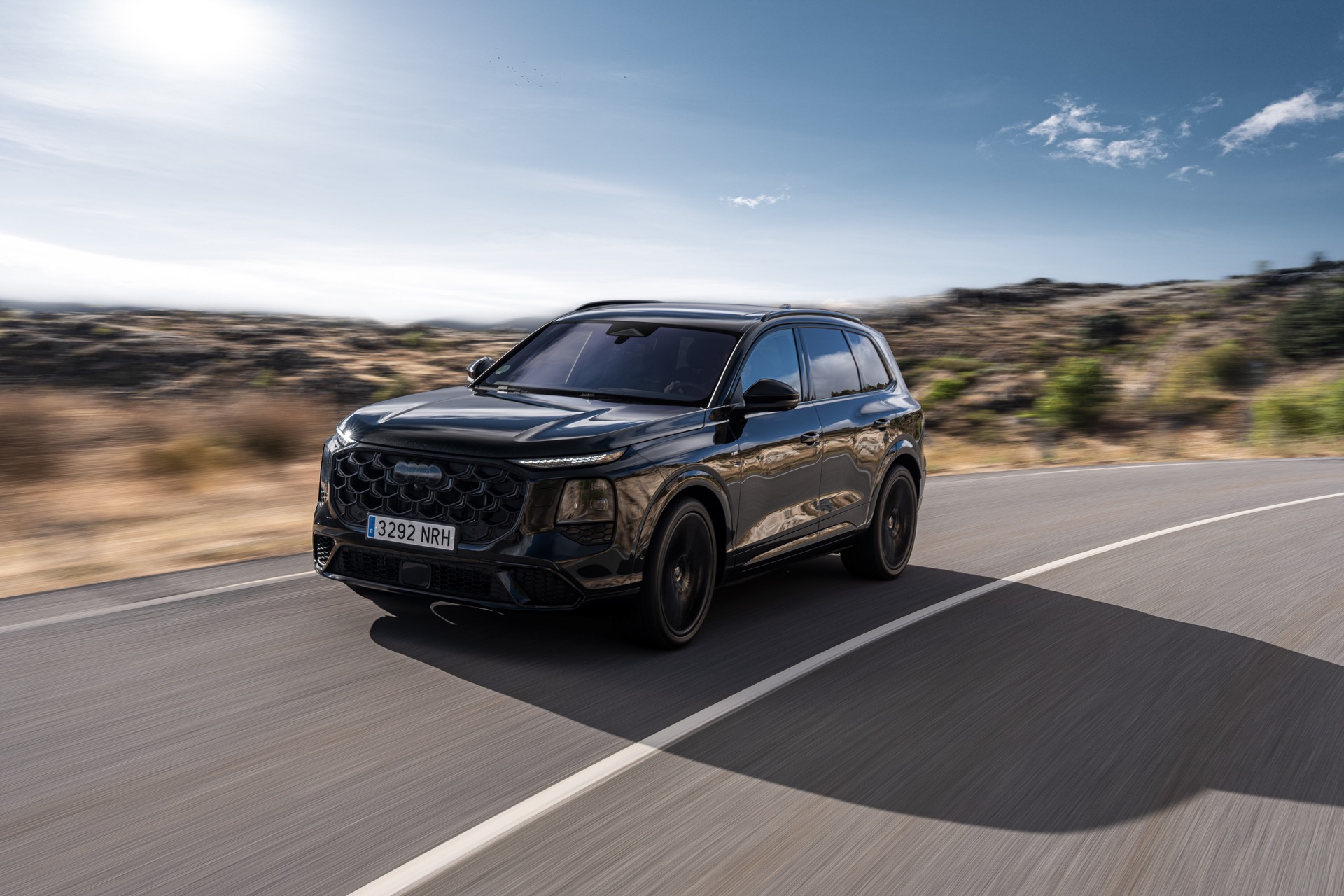
The third generation of the Audi Q7 arrives with a redesigned look, a more luxurious and technological interior and V6 TDI engines with an ECO label. We tested the 299 CV version to find out how this SUV, which surprises with its dynamism, behaves.
It has been a little over two decades since, back in 2025, Audi presented the first Q7. A model that not only marked the four-ring brand’s entry into the segment of large luxury SUVs, but also launched a family, the Q models, which over time has become one of the main pillars of its range. Around 550,000 units of that first generation were sold worldwide. A model that, as a curious fact, even came with a 12-cylinder, 6-litre TDI engine under the bonnet. Undoubtedly, those were different times, when diesel engines led sales in every segment… and Audi itself won the 24 Hours of Le Mans with an engine like the one later fitted to the Q7.
In 2015 the second generation arrived, which raised the bar in technology, comfort and efficiency and introduced novelties such as plug-in hybrid versions or the high-performance SQ7 variants. And here is another curiosity: the SQ7 was initially offered with a TDI engine, in this case a V8, and was later replaced by a twin-turbo TFSI, also with 8 cylinders. After more than 1.33 million units sold across the two generations (around 23,000 in Spain in total), the Q7 now faces its third generation with major changes in practically every area.
A complete overhaul to maintain the qualities that have always defined it
The new Audi Q7 keeps the qualities that have always defined what was the largest and most luxurious SUV in the brand until the arrival of the Q9: plenty of space, a high level of ride comfort and great versatility. But it adds a redesigned look, an even more digitalised cabin and new lighting, safety and driver-assistance technologies. It also incorporates, for the first time, a six-seat interior configuration.
And there is another particularity that stands out in today’s times: Audi has chosen two V6 turbodiesel engines to launch this third generation in our market, with outputs of 245 CV and 299 CV, tiptronic automatic gearbox, quattro full-time four-wheel drive and an ECO label thanks to the MHEV plus mild hybrid system. Plug-in hybrid e-hybrid variants will arrive later. For the moment there is no confirmation of a future SQ7, although everything points to one arriving sooner or later.
For now we have had the chance to drive the new Audi Q7 TDI quattro in its most powerful version during its national presentation, and we were surprised by how this new Q7 has adapted to today’s times and to its new role within the Audi range, as well as by its dynamic behaviour.
Exterior design of the 2026 Audi Q7: visually lighter, yet just as imposing
One of the first things that catches the eye of the new Audi Q7 is that, despite keeping dimensions very similar to its predecessor, it looks like a less bulky car. Not because it has lost its presence as a large SUV, but because the treatment of the surfaces and the new proportions manage to visually lighten the whole.
The third-generation Q7 measures 5,056 mm in length, 2,010 mm in width without mirrors and between 1,757 and 1,820 mm in height, depending on the configuration. In other words, it is still a very large car, although its design now disguises that size better. Much of the changes concentrate at the front. The Singleframe grille, which can optionally incorporate lighting and is now bigger than ever, has a more vertical design and is flanked by light units split into two levels. At the top sit the daytime running lights, which can offer different digital light signatures, while the main headlights are integrated lower down.
In profile, the widened wheel arches stand out, reinforcing the sense of robustness, along with a more vertical D-pillar. This last change, together with a practically horizontal roofline, also makes better use of interior space, especially in the rear seats. Wheels start at 20 inches and can go up to 23 inches, a diameter that Audi offers for the first time on the Q7, which previously stopped at 22 inches. As we will see later, this option has a lot to do with the car’s sporty image, but it also has an important influence on its ride comfort.
The rear has been completely redesigned, with third-generation digital OLED rear lights visually joined by a light bar running the full width of the vehicle. The result is a Q7 that retains its powerful appearance but which, in my view, looks more proportionate and visually less heavy than its predecessor.
Interior of the Audi Q7: three screens and outstanding quality of finish
If the exterior design represents an important evolution, the cabin represents an even bigger change. The new Audi Q7 adopts the digital architecture the brand is introducing across its latest models, with a dashboard dominated by the Audi MMI panoramic display system. This setup combines the digital instrumentation Audi virtual cockpit, which in the Q7 measures 11.9 inches, with a central OLED touchscreen of 14.5 inches, both integrated beneath a curved surface oriented towards the driver. To these is added a 12.3-inch LCD screen for the front passenger, included as standard from the entry-level version, already familiar from the brand’s latest models, including a privacy function to prevent distractions for the driver.
We also find the new arrangement of controls via satellite modules on either side of the steering wheel, while the centre console has been completely redesigned. As for these controls, I have to say that every time I test a Audi with this system, during the first few kilometres I miss the conventional indicator and light stalks, but in the end you adapt. If you ask me – and if I don’t say it the same way – I particularly prefer conventional controls.
As well as improving the sense of space in the new Q7, it incorporates a wireless charging zone for two mobile phones, with up to 25 watts of power per device and cooling to prevent them from overheating during charging. Electrically adjustable air vents, new personalisation options and standard ambient lighting, which can be extended through the ambient lighting plus package, complete an interior in which practically everything is new.
But, above the screens and the technology, if there is one thing I take away from the interior of the new Audi Q7 it is its exquisite finish and attention to detail. The quality of the materials, the fit and finish, the upholstery and the way the various elements are integrated convey a sense of solidity and refinement that remains one of Audi’s most important arguments against its rivals, and even more so now with the arrival of so many Chinese brands.
Among the new features are also the experiences modes, a series of customised ambience scenarios that combine interior lighting, music and screen presentation to create different atmospheres in the cabin. It is not a completely new idea, since manufacturers such as Mercedes-Benz have been offering similar solutions for some time. But it fits perfectly with the Q7’s commitment to improving the onboard experience.
A 4D sound system and a panoramic roof that also lights up
Audi has paid special attention to acoustic comfort and onboard entertainment. As well as the standard Audi sound system, you can choose a Bang & Olufsen 3D system with 16 speakers and 800 watts, or step up to a spectacular Bang & Olufsen 4D with 22 speakers and up to 1,360 watts of power.
The latter incorporates speakers in the headrests and actuators in the front seats that generate vibrations synchronised with the music. In this way, the bass is not only heard, it can also be physically felt through the seat, creating a more immersive sound experience. I have had the chance to test it and I can assure you it is absolutely spectacular, although I must also say that the standard audio system is more than sufficient for the vast majority. Its price is around 1,100 euros.
Another of the most eye-catching novelties is the panoramic sunroof. The ability to electronically adjust the opacity of the glass is not new, but Audi goes a step further by incorporating lighting into the roof itself, thus joining a new trend in which a rival brand, a German one no less, had also taken the lead. Through a pattern integrated into the glass and 78 LEDs, it can light up in different colours coordinated with the cabin’s ambient lighting.
In addition, transparency can be adjusted independently across nine segments, going from completely transparent glass to an opaque surface without the need for a conventional blind. When the car is parked, the roof also darkens automatically to preserve privacy inside.
The Q7’s lighting: indicators projected onto the asphalt
For years, Audi has made lighting technology one of its main hallmarks. And the new Q7 represents another important step forward, with solutions that not only offer a more sophisticated look, but also seek to improve safety.
Unlike “conventional” Matrix LED headlights, the optional digital Matrix LED headlights use micro-LED technology and allow high-resolution light patterns to be projected directly onto the road. This opens the door to new assistance functions, such as lane guidance and orientation lights, which can warn the driver of certain hazardous situations without the need to take their eyes off the road. For example, the system can project a warning when it detects the vehicle drifting unintentionally out of its lane, indicate the presence of another car in the blind spot, or display an ice symbol in certain risk conditions. It can also adapt the beam in roadworks and highlight the presence of pedestrians near the road.
But a world first that the Q7 debuts is what are called advanced indicators. When activated in darkness, they project a light signal onto the asphalt synchronised with the vehicle’s dynamic indicators. In this way, the intention to turn or change direction becomes more visible to other road users, especially pedestrians and cyclists. The truth is the effect is spectacular.
At the rear, the third-generation digital OLED rear lights allow you to choose different light signatures and feature what is known as communication light. Its function is to convey information to other drivers through specific light patterns. Thus, they can display warning signals in hazardous situations, indicate that the vehicle is performing an automated parking manoeuvre, or light up completely when another car approaches too closely from behind.
All of this is combined with details such as the illuminated Singleframe grille or the welcome light projections on the doors. Technology and design once again go hand in hand, but this time Audi has wanted lighting to play a more active role in safety too.
Audi Q7 with five, six or seven seats: more options for family travel
Versatility has always been one of the great virtues of the Audi Q7, and this third generation expands the possibilities with an unprecedented six-seat configuration, in addition to the usual five- and seven-seat layouts. In the six-seat version, the second row consists of two individual seats, an arrangement that, at least in theory, reinforces the feeling of travelling in genuine business class and improves occupant comfort. I say in theory because we did not have access to a unit with this configuration during the first contact. The third row also has two seats, while the seven-seat configuration keeps a central bench with room for three passengers.
Electric seat adjustment and the new comfort access system make it easy to use the rear seats. Audi has even considered families travelling with young children, since in the five- and seven-seat configurations up to three child seats can be installed in the second row. In addition, the mechanism for accessing the third row allows the central seats to be moved and tilted without removing the child seats.
Load capacity remains one of the Q7’s great selling points. In the five-seat versions, Audi quotes up to 806 litres of boot space depending on configuration and measuring criteria, a figure that can reach 2,075 litres with the second row folded down. In the seven-seat variant, with the third row folded, capacity can reach 722 litres, while the maximum volume is 1,980 litres.
Among the practical details is an electric tailgate that opens with a foot movement, with a very interesting detail: a light indicates the point where the gesture should be made so you don’t end up kicking at random. There is also an optional rail system for organising and securing the load.
Automatic doors: a technology we have tested and it works really well
Among the technological novelties of the new Audi Q7 is one that deserves a closer look: the automatic doors with electric operation. A solution that might seem more suited to a large luxury saloon, but which Audi now offers in its SUV.
The system allows the doors to be opened and closed electrically using various controls and has sensors that monitor the space around the vehicle to avoid collisions with obstacles. I had the chance to check how it works during the presentation. Obstacle detection works really well: whether there is a person, another vehicle or any element that prevents the door from completing its travel, the door stops before contact is made.
The automatic closing is also very convenient. Once inside the car, simply fastening the seatbelt or pressing the brake pedal is enough for the system to close the door, without needing to pull it shut. Obviously, it is a completely dispensable option. And its operation takes a little longer than that of a conventional door. But it is one of those details that, beyond the initial surprise effect, add an extra touch of comfort and sophistication to everyday use. This option is included in an optional package we will discuss later, but I can tell you in advance that it is not exactly cheap…
Driver assistance: the new Q7 can memorise how to park in your garage
The new Q7’s technological evolution also extends to driver-assistance systems, with particular emphasis on parking functions. This is especially interesting in a car that exceeds five metres in length and two metres in width.
The park assist pro system expands the possibilities of automated manoeuvres. Its functions include a reverse assistant, capable of memorising a route of about 50 metres and replaying it in reverse, which is very useful for getting out of a narrow street or a difficult access point. For its part, trained parking allows you to teach the vehicle certain manoeuvres so that it can then repeat them automatically, always under supervision. It can store up to five routes of up to 200 metres each. Remote parking manoeuvres from a smartphone with the corresponding app are also possible.
On the road, the adaptive driver assistant plus combines speed and distance control with lane-keeping functions, also making use of cloud data to optimise its operation. Another of the most interesting safety novelties is the emergency assistant with steering towards the hard shoulder. If it detects that the driver is not responding to warnings, it can progressively reduce speed and, under certain motorway driving conditions and provided there is adequate free space, steer the car towards the hard shoulder to stop it and make an emergency call.
Audi Q7 TDI quattro with 299 CV: a great diesel that still has a lot to say
It has been a long time since I encountered a diesel engine at the presentation of a completely new car. With electrification dominating much of the latest launches, it is increasingly rare to get behind the wheel of a new model whose range starts exclusively with combustion engines… and even rarer for them to be diesel. But Audi has decided that the TDI still has a lot to say in an SUV like the Q7.
Initially two versions of the 3.0 V6 TDI engine are offered, with 245 CV and 500 Nm or 299 CV and 630 Nm of maximum torque. Both share the same mechanical architecture and differ mainly in their tuning and electronic management, as well as coming as standard with the eight-speed tiptronic automatic gearbox and quattro permanent all-wheel drive.
They also use the 48-volt MHEV plus mild hybrid system, which allows them to obtain the DGT ECO label. But this is not a conventional micro-hybrid, limited to recovering energy and assisting the combustion engine in certain circumstances. MHEV plus technology incorporates a generator integrated into the propulsion system capable of temporarily delivering up to 18 kW, equivalent to 24 CV, and an additional 370 Nm. This assistance even allows brief fully electric journeys in certain conditions, for example when manoeuvring, parking or driving at low speed. It does not turn the Q7 into a conventional hybrid, but it does improve the efficiency and responsiveness of the whole.
Added to this is an electric compressor EPC, which works alongside the turbocharging system to generate pressure almost instantly and minimise engine response lag when accelerating. A combination of technologies that, on paper, is very interesting and that in practice proves its effectiveness.
During this first contact we drove the most powerful version, with 299 CV, which claims an acceleration of 0 to 100 km/h in 6 seconds and a homologated combined consumption of between 7.2 and 8.0 l/100 km, depending on equipment and configuration. The result struck me as outstanding. It is true that the engine does not completely hide its diesel nature and that, especially from the outside, its operation can be felt. But once behind the wheel, there is no reproach to make either in pulling power or in refinement.
The V6 moves the Q7 with surprising ease. The delivery of torque is forceful from very low revs, the throttle response is practically immediate and the tiptronic gearbox takes care of using all that potential smoothly. The cabin’s insulation also helps make the on-board experience especially pleasant. Very little mechanical noise reaches the interior, and the engine shows a recovery capacity that allows overtaking with an enormous reserve of power, without constantly needing to downshift.
In short, it is one of those engines that reminds us why for so long large six-cylinder turbodiesels have been a benchmark for long-distance travel. And electrification, far from distorting its character, helps to improve its qualities even further.
Dynamic behaviour of the Audi Q7: surprising
If the engine is convincing, the dynamic behaviour is probably what has surprised me most about the new Q7. Because it is one thing to expect an SUV of this size to be comfortable and composed on the motorway, and quite another to find out how easily it can handle a winding road.
Audi offers three suspension alternatives. The standard one uses steel springs, while optionally you can choose an adaptive air suspension tuned for comfort or an adaptive sport air suspension, which lowers the body height by 30 millimetres. In both cases, whether with the comfort or sport running gear with adaptive suspension, four-wheel steering is included, which is largely responsible for the agility the Q7 shows on winding roads and improves low-speed manoeuvrability and stability when the pace increases. The price of these special running gear packages is between 4,345 and 5,225 euros.
During our test we drove units equipped with the sport running gear and 23-inch wheels with very low-profile tyres. A combination that has its advantages, but also requires accepting certain compromises. Starting with the less favourable side, the enormous 23-inch wheels clearly penalise comfort over potholes. On motorways and roads with well-maintained asphalt, the Q7 rides with outstanding quality. However, when irregularities, joints or potholes appear, the low tyre profile means impacts are transmitted more harshly than one would expect from an SUV designed for maximum comfort on long journeys.
This is not a problem of general insulation or stability, but of the configuration itself. Personally, I think that anyone who prioritises comfort should consider smaller-diameter wheels, which will offer a more appropriate balance for a vehicle of this kind. The trade-off, however, is a truly impeccable dynamic behaviour. The new Q7 surprises with how easily it changes direction and how precisely it tackles bends. The permanent quattro four-wheel drive incorporates a new preloaded self-locking central differential, designed to improve responsiveness and torque distribution, especially in situations of rapid changes of load.
The result is that, on a winding road, the Audi Q7 feels much lighter and more agile than its dimensions and weight would suggest. Of course, the more than five metres of length and the more than 2.5 tonnes do not disappear as soon as you travel with a passenger and some luggage. But the way the chassis manages its inertia is truly remarkable.
In fact, you end up driving with a confidence you would not expect to find in an SUV of this size. The precision of the front end, the efficiency of the all-wheel drive and the excellent control of the bodywork mean the Q7 seems considerably smaller when the bends arrive.
A virtue that should not make us forget that its natural habitat is still long-distance travel, where it can make the most of its space, its insulation and the capability of its engine. But it is clear that Audi has not limited itself to developing a large, comfortable SUV: it has also wanted it to be pleasant and effective to drive.
Audi Q7 2026: equipment and prices in Spain
The price of the new Audi Q7 starts from 95,630 euros for the 245 CV version in Advanced trim, while stepping up to the 299 CV engine costs almost 3,000 euros more. Lacking a test of the less powerful Q7, I would pay for it.
The S line versions carry a premium of 5,700 euros, adding 21-inch wheels, the S line exterior and interior packages, an illuminated grille, sport seats and the ambient lighting plus system. The Black line versions cost 7,300 euros more than the S line, and on top of the S line content you also get 23-inch wheels, sport seats plus, black exterior pack and tinted glass.
The options catalogue is almost a book in itself, but I would highlight two interesting packages. The comfort package, costing 7,300 euros, adds a panoramic roof with transparency adjustment, park assist pro, adaptive driver assistant plus, four-zone climate control, rear OLED lights, surround cameras and front and rear emergency braking assist. The premium package is priced at 12,700 euros and includes everything in the comfort package plus automatic doors, HD Matrix LED digital headlights, head-up display and 3D sound system.
Verdict on the new Audi Q7: is it worth continuing to bet on a large diesel SUV?
Audi has managed to evolve the Q7 without losing the qualities that have always defined the model. It remains a large, luxurious SUV, especially suited to those seeking space and comfort on long journeys, but now adds a more versatile interior, a very significant technological leap and a dynamic behaviour that deserves special mention. Of everything it offers, I particularly value two things: the quality and attention to detail that pervade the cabin, and the agility it shows behind the wheel, even in a configuration as demanding for comfort as the units we tested, with 23-inch wheels.
The 299 CV V6 TDI engine has also won me over. Its performance is magnificent, it offers excellent smoothness and MHEV plus technology improves its efficiency without giving up the qualities that have always made large diesels attractive. Another question is what its commercial role will be when the e-hybrid plug-in versions arrive, which will have the CERO label in their favour and the ability to cover much of daily travel without burning fuel. In that scenario, the TDI variants will have to defend their case, especially for those who cover many kilometres on the road.
Although diesel holds one ace up its sleeve: if you need a seven- or six-seat Audi Q7, you will have to choose a TDI version, since the plug-in hybrid variants will only be available with five seats.
What other options are there for the price of a Audi Q7?
Among the alternatives to the Audi Q7, if you are looking for maximum comfort, one of the main references is the Mercedes Benz GLE. The large SUV from the star brand also has turbodiesel versions with an ECO label and seven seats, such as the GLE, available in 350 d versions with 286 CV and 450 d with 367 CV. A model that has also been recently updated and is a tough rival for the Q7.
Nor can we lose sight of the fifth generation of the BMW X5, which does not have seven-seat versions but does offer petrol, diesel, plug-in hybrid engines and even a 100% electric variant. If you want a touch more sportiness, the X5 40d xDrive, with 313 CV, is a very interesting alternative.
And if we set aside the type of fuel and look for alternatives to the Audi Q7 as large SUVs with a budget around the 100,000 euros the four-ring model costs, there are options as different as a Defender 110 or a Ineos Grenadier for those focused on off-road qualities, or even a Porsche Cayenne Electric for those who, in addition to luxury, prestige and sportiness, want nothing to do with petrol or diesel.
Audi Q7 V6 TDI quattro – Image gallery
Technical specifications of this car

 Kia offers an electric range of 10 models, 50 versions and 400 possible combinations
 The seven finalists for the 2027 European Car of the Year (COTY) are exclusively electric
 Peugeot E-208 GTi: a battery-powered toy that revives the spirit of the 1980s sports cars
Deja un comentario