EBRO s700 Hybrid Cars Tests SUV
EBRO s700 HEV: 140 kilometres to Segovia to find out how the new Spanish hybrid SUV behaves on the road… and on medieval cobblestones
 Óscar Sanz
2 September 2026
8 min.
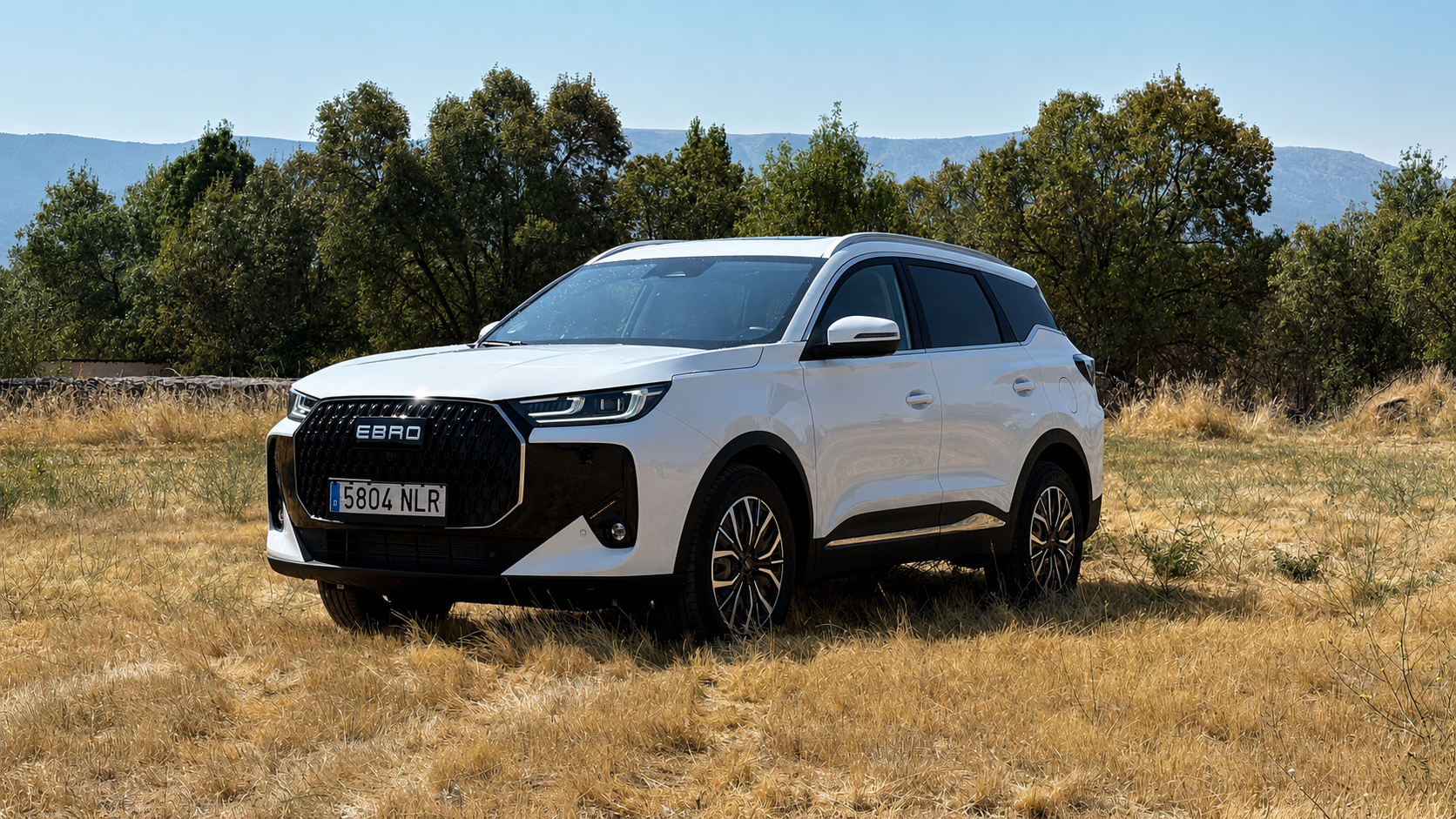
Road test of the new EBRO s700 HEV: 224 CV, ECO label and 900 km of range for one of the most interesting hybrid SUVs on the market right now
The EBRO s700 HEV expands the range of the Spanish brand’s SUV with a full hybrid powertrain designed to combine performance, efficiency and ease of use without depending on a charging point. To check how all these ingredients come together beyond the spec sheet, we drove a route of around 140 kilometres between Madrid and Pedraza, crossing the Sierra de Madrid and the area around the Somosierra pass before tackling secondary roads and finishing on the narrow cobbled streets of one of Spain’s best-preserved medieval towns.
The destination added a special appeal to this test. Pedraza, in Segovia, is a walled medieval town that has kept its historic centre practically intact, with a single traditional gate, cobbled streets, stately houses, a main square, a castle and city walls. Its heyday came during the 16th and 17th centuries thanks to the production of merino wool cloth. The contrast could hardly have been greater: seeing how a SUV of Chinese origin with cutting-edge hybrid technology copes among centuries-old buildings and on a surface that has little in common with motorway asphalt.
4.55 metres and a clearly family-oriented layout
The EBRO s700 HEV measures 4,553 mm in length, 1,862 mm in width and 1,696 mm in height, with a wheelbase of 2,671 mm. Its kerb weight is 1,692 kg and it seats five. Ground clearance is 177 mm, while the approach and departure angles are 19.2 and 27 degrees respectively.
It does not pretend to be an off-roader, something its front-wheel drive and overall design make clear, but those dimensions proved particularly useful on a route where, upon reaching Pedraza, conventional tarmac gave way to irregular cobbled streets.
Outside it keeps the design already known from the s700, with fairly balanced proportions and a presence closer to a traditional family SUV than to some of the more daring designs now arriving from China. The result is a voluminous car that does not look excessively bulky, something that matters once you leave the motorway and the road begins to narrow.
A spacious interior that improves where it really counts
The cabin keeps practically intact the layout of the other s700 versions, but the HEV introduces some especially welcome changes.
The most important one is seemingly simple: EBRO has brought back a row of physical controls for some climate functions. At a time when most manufacturers are moving almost every control to the touchscreen, having buttons within easy reach without taking your eyes off the road is a real ergonomic improvement. The gear selector also changes, adopting a more conventional design and synthetic leather trim.
In front of the driver are two 12.3-inch screens, one for the instrument display and another for the multimedia system. From the Comfort trim onwards it includes features such as LED headlights, rear camera, electric tailgate and 18-inch alloy wheels, while the Luxury adds perimeter cameras, Eco Skin upholstery, heated front seats, a head-up display, 19-inch wheels and a Sony sound system.
The s700 stands out above all for its sense of space. It is designed to carry five occupants and offers a well-used cabin, with a high driving position and a good perception of the available room.
As for the boot, EBRO’s official specification gives 369 litres of base capacity, 484 litres depending on the loading configuration, and up to 1,269 litres with the rear seats folded.
224 CV and a hybrid system that works in three ways
The major novelty lies under the bonnet. The s700 HEV uses a hybrid system made up of a 143 CV 1.5 turbo petrol engine, running on the Miller cycle, and two electric machines.
One of them produces 136 CV and acts mainly as a generator, while the other delivers 204 CV and is responsible for driving the front wheels. The combined maximum power of the system reaches 224 CV (165 kW) and peak torque is 295 Nm. The high-voltage battery has a capacity of 1.83 kWh and uses NMC chemistry.
Transmission is an automatic 1DHT specific to the hybrid system, and its operation changes continuously depending on the vehicle’s needs.
It can move for short periods on the electric motor alone; work as a series hybrid, with the petrol engine generating electricity while the electric motor drives the wheels; or operate in parallel, with both the combustion and electric units contributing to propulsion.
The interesting part is that the driver does not need to manage any of these processes. The vehicle itself automatically selects the most efficient strategy based on battery charge and power demand.
From Madrid to Somosierra: where the s700 HEV had to prove its balance
The first kilometres out of Madrid were used to check precisely one of the main arguments for a full hybrid: ease of use.
There is no need to worry about charging a battery or constantly selecting different driving modes. The system decides on its own when to use electric power, when to start the combustion engine and when to combine both.
The route towards Pedraza also allowed us to gradually leave the urban environment and tackle motorway and then increasingly demanding roads close to the mountains.
The s700 HEV introduces a specific chassis tuning developed to better suit European market preferences, with slightly firmer suspension and a new steering calibration. The front suspension uses a McPherson layout and at the rear there is an independent multi-link system.
On fast roads its orientation is clear: it is essentially a SUV built for travelling. The chassis setup aims to control body movements without sacrificing absorption capacity, and the steering has sufficiently progressive assistance to keep the car stable at high speeds.
When full power is demanded, the hybrid system has one peculiarity. Maximum output does not arrive completely instantly after pressing the accelerator fully; the electronics need a brief interval to coordinate the different motors. Once all the thrust is delivered, performance is in line with the advertised 224 CV; in independent measurements, the s700 HEV has recorded 5.8 seconds for the 80 to 120 km/h overtaking manoeuvre.
From the mountain pass to the streets of Pedraza
But the most interesting part of the route came after leaving the fast roads.
The roads near Pedraza allowed us to assess the chassis work in a far more demanding setting than the motorway, with changes of camber, linked bends and a less uniform surface.
Then came the less conventional test: taking a 4.55-metre-long hybrid SUV with technology developed in China into the historic fabric of a Castilian town with narrow streets and cobbled paving.
Pedraza preserves its medieval layout, its walls and a single historic entrance to the town, and much of its streets retain traditional cobbles. That is precisely why it was an interesting setting for checking aspects that rarely appear on a spec sheet: how easy it is to modulate the accelerator at low speed, how the suspension handles continuous irregularities, and manoeuvrability in tight spaces.
How much does the EBRO s700 HEV consume?
EBRO homologates a combined WLTP consumption of 5.7 l/100 km, with 5.5 l/100 km on the low-speed cycle, 4.8 l/100 km at medium speed and 4.9 l/100 km in the high-speed phase of the homologation procedure. The fuel tank has a capacity of 51 litres. During our test we measured consumption close to 5.2 l/100 km on urban and peri-urban routes, while at 120 km/h on the motorway the figure can rise to around 7 l/100 km.
Price and range of the EBRO s700 HEV
The range is built around the Comfort and Luxury trim levels. EBRO’s official configurator currently lists the s700 HEV Comfort from €27,490, while the Luxury trim costs €2,000 more, starting at €29,490, before any additional options.
It is a relatively modest difference considering that the Luxury adds features such as perimeter view cameras, the head-up display, heated seats, the Sony sound system and 19-inch wheels.
Technical specifications of this car

 Kia offers an electric range of 10 models, 50 versions and 400 possible combinations
 The seven finalists for the 2027 European Car of the Year (COTY) are exclusively electric
 Peugeot E-208 GTi: a battery-powered toy that revives the spirit of the 1980s sports cars
Deja un comentario